
Editorial. The Imprint of the Trinity on the Person, Culture, and Creation
Article Sidebar
Main Article Content
Abstract
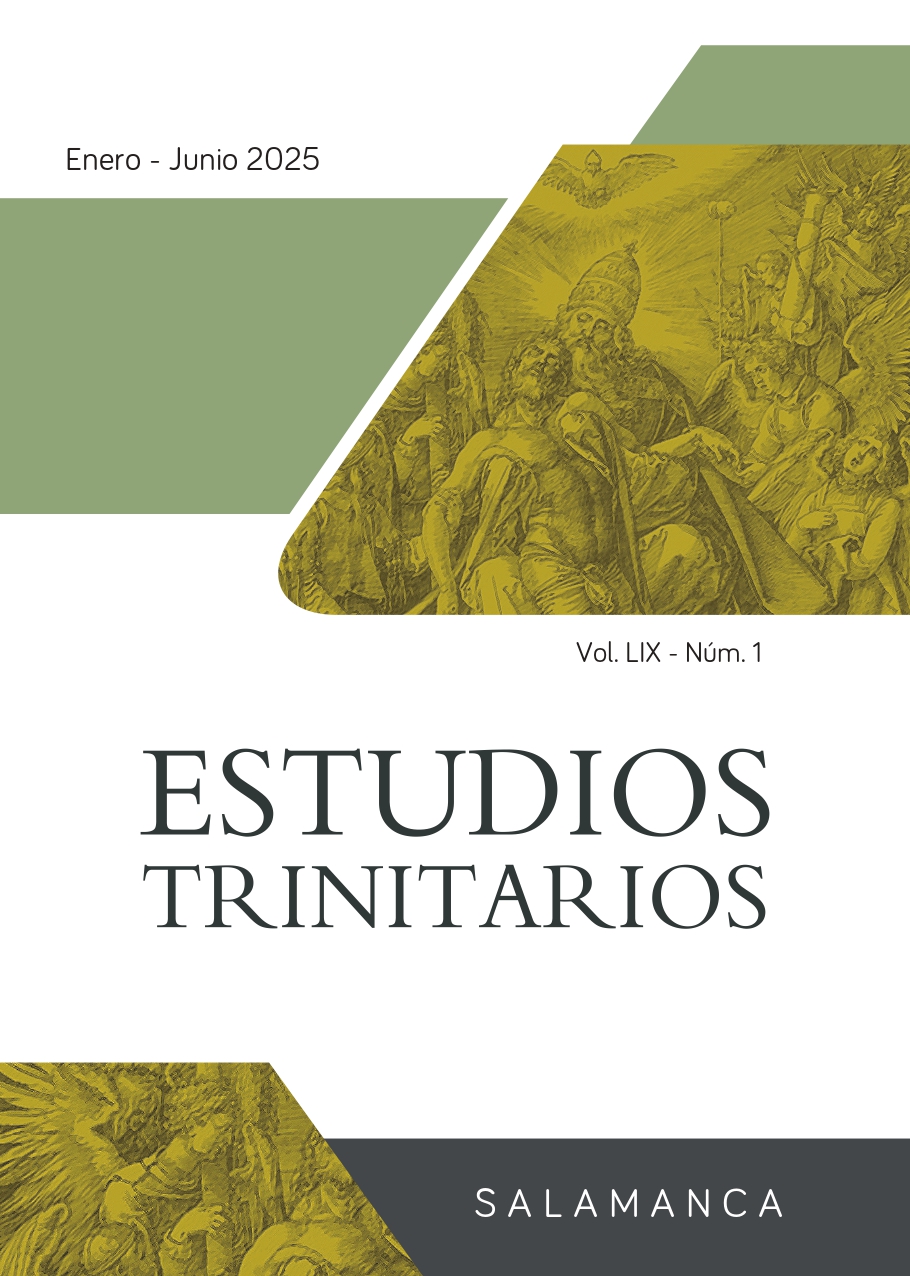
The first regular issue of volume fifty-nine of Estudios Trinitarios, corresponding to the year 2025, includes a diverse selection of four academic studies that articulate an interdisciplinary journey around the Trinity as a theological, anthropological, aesthetic, and ethical key, demonstrating its fruitfulness for thinking about the Christian faith in dialogue with contemporary culture. The four articles gathered here address, from complementary perspectives, the relationship between the Trinitarian Mystery and human experience, personal freedom, artistic expression, and social commitment. From systematic and spiritual theology, the primacy of love in Trinitarian understanding is explored; from art history, post-Tridentine iconographic criteria for the representation of the Mystery are analyzed; from contemporary theology, two fundamental conceptions of personhood and freedom are confronted; and from moral and pastoral theology, climate justice is presented as an ethical requirement derived from an eco-theology with Trinitarian roots. Taken together, the articles offer an integrated vision that highlights the relevance and transformative power of Trinitarian thought in today's world.
Downloads
Global Statistics ℹ️
|
129
Views
|
103
Downloads
|
|
232
Total
|
|
Article Details

This work is licensed under a Creative Commons Attribution-NonCommercial-NoDerivatives 4.0 International License.
Previously, the journal operated under a traditional copyright regime. As of 2025, the journal is published under a Creative Commons license.
Authors who publish in Estudios Trinitarios agree to the following conditions:
- Authors retain copyright © and grant the journal the right of publication under the Creative Commons Attribution–NonCommercial–NoDerivatives 4.0 International License (CC BY-NC-ND).

- The content may be copied, used, shared, transmitted, and publicly displayed provided that:
- Give proper attribution to the author(s) and to the publication in Estudios Trinitarios, indicating the volume, issue, year, and the page numbers on which the information is found.
- No commercial use is made of the material.
- No derivative works may be created for commercial purposes without the authorization of the journal.
Authors are permitted and encouraged to disseminate their articles electronically (including full citation details: Estudios Trinitarios, volume, issue, year, pagination, ISSN, DOI, etc.) in order to enhance circulation and dissemination and to increase citation and academic impact within the scholarly community.
Information about the journal will be supplied to Dulcinea and SHERPA/Romeo.